
Body of evidence
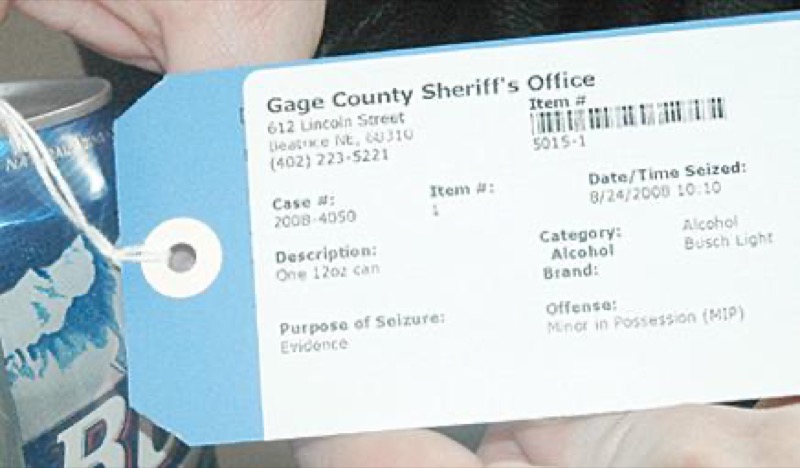
One space-saver in the Gage County Sheriff's Office evidence room comes from a new rule. Instead of storing all of the alcohol confiscated in a minor in possession case, just one item has to be tagged and stored, while the rest can be destroyed after photographs are taken.
Inside, there are a number of confiscated items, ranging from rifles and shotguns to illegal drugs, and even a medieval knight’s helmet.
“That is probably the strangest thing we’ve ever got in there,” Sheriff Millard “Gus” Gustafson said of the helmet currently kept in Gage County’s evidence room.
Rob Sandersfeld, evidence custodian, decides what goes where in the over-crowded room.
Sandersfeld said the process of collecting evidence has changed with new technology.
“It used to be that an officer would take (the evidence) and find a spot somewhere in the room. Now it’s logged into a computer that shows when it came in and how long it’s been there,” he said.
When an officer brings in evidence, he or she logs it into a temporary holding locker. The software program e-mails Sandersfeld and he takes the items out of the temporary locker and moves them to a permanent spot in the evidence room, and then logs that into the program.
“The evidence stays there until the court case is done. The owners have 30 days after we contact them to pick it up.”
The program will also send e-mail reminders to Sandersfeld, asking him to review a case for which evidence has sat in the room for too long.
It has taken Sandersfeld almost a year to clear out much of the evidence room for organization and logging into the software program.
Currently, Sandersfeld said he is clearing out old evidence that is not necessary to hold on to anymore.
While owners have 30 days to pick up their confiscated items, the items must be legal. Illegal items stay in the custody of the sheriff’s office.
Guns. More than 100 of them, sit in the tiny evidence room, ready to return to their owners. With cases now over, Sandersfeld said sheriff’s office staff are helping him go through to find which guns are legal and who they belong to. Many of the guns have been stolen.
The guns are some of the items left behind that Sandersfeld is sorting out. He has to send them in small bunches to a ballistics team to make sure that the specific weapon was not used in a crime and can be returned to its owner.
If no owner can be found or the gun isn’t claimed within 30 days, Sandersfeld destroys them.
“(The guns) are taken to a shop in town. We have to witness them use this big saw to cut them up,” he said.
A recent rule change has helped Sandersfeld save space.
Previously, when there was a minor in possession of alcohol case, officers were required to keep all of the alcohol confiscated in evidence.
“We used to have to just throw stuff in a van out (in the garage),” he said.
Now officers are only required to keep one piece of what is confiscated and can dispose of the rest.
As for homicide cases, Sandersfeld said evidence is never allowed to be thrown away.
Because of this, a large shelf in the evidence room is filled with bags and boxes with items from homicide cases.
Sgt. Joseph Kubicek, another evidence custodian, is the only other person who has access to the room.
Kubicek works with the substance-abuse part of the evidence room, and he’s responsible for figuring out what to do with confiscated illegal drugs and drug paraphernalia.
Kubicek said he has a collection of controlled substances ranging from marijuana and cocaine to methamphetamine and LSD.
He also keeps paraphernalia in the evidence room.
Using the confiscated items, he puts on presentations, educating other officers on what controlled substances look like and what paraphernalia is used.
Kubicek works with the local fire and rescue teams educating them on meth lab awareness so that everyone knows what to do in case of a meth lab fire, or even the signs and symptoms of someone who is under the influence of a controlled substance.
Kubicek, Gage County’s K-9 handler, also uses the confiscated items to train drug-sniffing dogs.
If he doesn’t need to keep the drugs, he will dispose of them and document the means of disposal, Sandersfeld said.
The drugs are put in an incinerator for disposal by state lab employees.
Kubicek said that not only space, but safety, can be an issue with the current evidence room.
With a bond issue for a new jail likely to be voted on in spring, Kubicek hopes for a new evidence room, one with more space and more up-to-date.
“We have to store what we get from meth labs, those hazardous materials, or bomb materials. We don’t want to be putting that with the rest of the stuff,” Kubicek said.
He said more advanced storage is also needed for drying evidence from assaults or for storing blood for DNA testing.
“Right now that’s all in a refrigerator,” he said.
Overall, Sandersfeld said a lot of the items will be destroyed as the clearing out of outdated items continues.
He hopes to do this process more often because the space in the evidence room is limited.