
Keeping watch
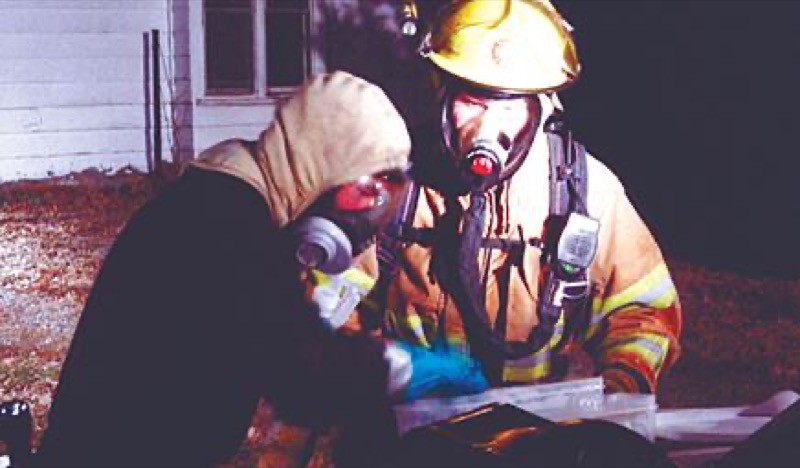
In 2004, Gage County reported 19 methamphetamine labs to the El Paso Intelligence Center (EPIC) — the Drug Enforcement Administration’s (DEA) intelligence information processing center.
In 2005, 31 were reported.
After a crack down on labs by law enforcement and help from the community, 2006 numbers were brought down to only five labs, followed by just one in 2007, according to EPIC.
Gage County Sheriff Millard “Gus” Gustafson said, though the official numbers aren’t out yet, 2008 showed zero meth labs in Gage County.
In the first few months of 2009, there have already been three, he said.
Tara Kuipers, Gage County MAPS coalition director, said she and Gage County officials are worried the number is going to keep going up.
“In 2004 and 2005, there was a high number of things happening. A lot of people were getting charged with controlled substance possession and a lot of them were put in prisons. Most of them got 4- to 5-year sentences,” she said.
Now, as offenders are getting out of prison, the numbers have started to rise again.
Though the three meth labs found in 2009 are not repeat offenders, Gustafson said he agrees that this could be a cause for higher lab numbers.
Gustafson believes the struggling economy could also lead to increased meth production.
“(Methamphetamine producers) can make it, sell it and make a load of cash,” he said.
In fact, the going rate for a gram — or about.035 of an ounce) — is around $100, according to the Midwest High Intensity Drug Traffic Interdiction (HIDTA).
County Attorney Randy Ritnour had another speculation for the upswing in meth labs.
“A lot of meth comes from the super labs in Mexico,” he said.
With a military push on Mexican drug cartels, supply from the super labs is getting lower in both quantity and quality.
“The quality is going down. They’re cutting it to make more of a supply,” Ritnour said.
Ritnour thinks the demand for Gage County producers is going up.
“Meth use didn’t decline, just the production,” Kuipers said.
She said she believes many meth offenders have been honing their skills while in prison.
“Now, it’s funny to say, but there’s better technology,” she said.
Gustafson said the Sheriff’s Office still keeps an eye on meth use and production in the county, as it is still a problem.
He said law enforcement greatly depends on community help.
“Ninety-five percent of what we find is from the public calling and saying ‘This doesn’t look right.’”
Eyes in the community
“We need those extra eyes out there watching, more than just us here (at the Sheriff’s Office),” Gustafson said.
Gustafson said his department has worked to get the community and different departments involved and aware of possible meth labs.
Sgt. Joe Kubicek does presentations for the public and for departments around the county to increase awareness of meth lab signs.
Kubicek most often does presentations for the people who deal with methamphetamine labs once they explode — the fire department.
“I tell them what to look for, teach them recognition — to recognize if there actually is a methamphetamine lab, and how they need to be safe,” he said.
The Beatrice Police Department has also worked hard to keep methamphetamine use down in the area.
Chief Bruce Lang said the City of Beatrice has only had one meth lab reported in the last three years.
“We have a two-fold approach, and that is education and enforcement. We want to make sure that people know if they use the drug or sell the drug, there’s a good chance they’ll get arrested and put in prison,” Lang said.
“As for education, we did a lot of education a few years ago that went toward reducing the demand for the drug. The side effects, overdoses, those kinds of things associated with the drug that we were finding, seems to have gone down significantly.”
If someone suspects a neighbor is producing methamphetamine, the Nebraska Meth Watch Program has some tips for reporting suspicious activity.
Suspicious activity can be random traffic at odd times of the day staying for only a few minutes, odd smells like cat urine, old milk jugs, pop bottles or screw-top beer bottles with mysterious liquids inside, stained coffee filters and lithium batteries, people bringing in valuable like televisions or other appliances and leaving without them, poor upkeep of the house or personal property, people exchanging small packets for cash or noticing needles in garbage piles or on lawns, along with anything else that may seem out of the ordinary.
Gustafson said that it’s not a good idea to do personal checks on the scene. Leave that up to law enforcement who are trained on how to handle these situations.
“Don’t touch. Call us, even if it’s just a suspicion, and we’ll check it out,” Gustafson said.
Helpful laws
In 2005 and 2006, two laws were put into place that limited the purchase of pseudoephedrine.
Pseudoephedrine, a main ingredient in methamphetamine, was an over-the-counter item and people of any age could purchase it.
It can be found in products like Sudafed, or other similar cold and allergy medications.
In May 2005, LB 117 was signed by Gov. Dave Heineman.
The law limits the amount of pseudoephedrine an individual can purchase in one month to nine grams and requires that purchasers be at least 18 years old with a valid photo identification. All pseudoephedrine products were moved behind the counter, or into locked cabinets near the counter.
On April 8, 2006, a law became effective nationally that limited the daily sales of pseudoephedrine to 3.6 grams and nine grams over a 30-day period.
With that law, all non-liquid forms of the drug had to be sold in blister packs and mail-service pharmacies had to verify the patient’s identification before shipping pseudo-ephedrine to them.
In Gage County in 2009, there have been eight cases in both Gage County and District Court involving possession, distribution and production of methamphetamine, Ritnour said.
For possession of methamphetamine, a Class IV felony, the sentence is a maximum of five years in prison, a $10,000 fine or both.
For possession with intent to deliver, a Class III felony, the sentence is a maximum of 20 years in prison, a $25,000 fine or both.
For delivering methamphetamine in a school zone, it goes up to a Class II felony — a maximum of 50 years in prison.
The next step
Departments have not backed down.
Statewide programs like Nebraska Meth Watch are stepping up community awareness, because those extra eyes for law enforcement are still needed.
Drug Court is almost full, Ritnour said.
Drug Court is a program that is used to benefit a felon convicted due to their addiction to a drug.
Currently, 34 people are enrolled. Of those enrolled, 22 used methamphetamine as their drug of choice, said Christina Lyons, Drug Court coordinator.
Drug Court is a four phase program that, if completed, can dismiss a felony charge.
If accepted, the county attorney and defense attorney must sign off on their enrollment and then an interview process is held.
The interview, Lyons said, most often eliminates those with delivery charge or intent to deliver, or those who are drug dealers.
The four phases include an intensive first step, consisting of close supervision and regular drug tests, court visits and community support meetings, like Alcoholics or Narcotics Anonymous.
There are six people currently in their last stage, Lyons said, who are almost ready to graduate.
“We help several people that methamphetamine is their drug of choice,” she said.
More information:
What meth does
In all forms, the drug stimulates the central nervous system, with effects lasting anywhere from four to 24 hours. Methamphetamine use can not only modify behavior in an acute state, but after taking it for a long time, the drug literally changes the brain in fundamental and long-lasting ways. It kills by causing heart failure (myocardial infarction), brain damage, and stroke and it induces extreme, acute psychiatric and psychological symptoms that may lead to suicide or murder.
Reasons many people start the drug
Athletes and students sometimes use meth because of the initial heightened physical and mental performance the drug produces. Blue collar workers may use the drug to work extra shifts, while young women often begin using meth to lose weight. Others use meth recreationally to stay energized at "rave"parties or other social activities. In addition, meth is less expensive and more accessible than cocaine.
Physical effects
Pupil dilation, respiratory disorders, dizziness, tooth grinding, impaired speech, dry or itchy skin, loss of appetite, acne, sores, numbness, and sweating.
Information from the Nebraska Meth Watch Program and Midwest HIDTA