
The brave boy
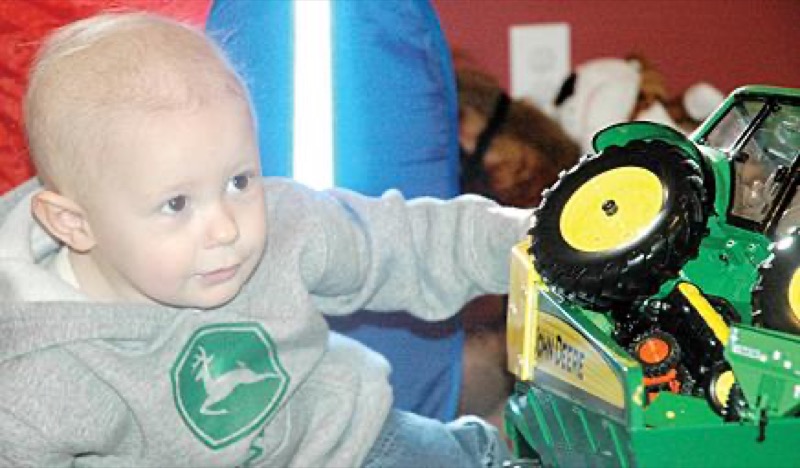
Elijah Ruegge, 23 months, plays with handfuls of toy cars and tractors. Ruegge of Pawnee City was diagnosed with leukemia in October and is battling the cancer along with his parents, Bryan and Betty.
PAWNEE CITY — To anyone else, this blond-haired boy is a normal farm kid.
The 23-month-old likes to watch his mother’s horse run back and forth in the pasture. He plays only with toys modeled after farm machinery or fast cars. He knows the makes and models by heart.
“Beep beep beep,” he says, backing up his toy John Deere dump truck. He lifts the back and dumps the load — all of his cars and tractors — gifts for his second Christmas.
One would never guess Elijah Ruegge has leukemia.
The Diagnosis
Betty Ruegge knew something was wrong with her son, she just didn’t know what.
“His glands had swollen suddenly,” she recalled of early October.
Knowing this wasn’t normal, she took him to his doctor immediately.
She watched as doctors and nurses did blood tests on her young son.
Something was wrong, the doctor told her. Elijah’s white cell blood count was very high. He must be fighting off an infection.
One virus after another, the doctor ruled them out. Elijah tested negative for all of them.
With no answer, the doctor treated Elijah with an anti-inflammatory and an antiobiotic.
“Elijah plays with a lot of farm cats, and he thought it might have been a cat scratch infection.”
In a short 10 days, Betty and her husband Bryan watched Elijah’s condition get worse. Whatever the doctor did wasn’t working.
Immediately, Elijah’s doctor set up an appointment with another doctor — an ear, nose and throat specialist in Topeka, Kan.
The Ruegges drove from their home near Pawnee City to Topeka, hoping that this would be the day that Elijah would be better.
The specialist told them they thought it’s an abscess behind the lymph nodes. He admitted Elijah into the hospital.
Three blood tests were ran in a row. The ENT was sure the tests were in error. Elijah’s white blood cell count was measured at 80,000 to 90,000. A normal count is around 10,000, the ENT told the Ruegges.
“That meant there were abnormally-growing cells,” Betty remembered, but at the time she wasn’t sure what that meant.
It’s just precautionary, the ENT and nurses ensured Bryan and Betty, but it was decided to run a hematology test for lymphoma or leukemia.
Betty knew her son had one of them. And she knew that the doctors and nurses were trying to keep her calm. She appreciated that. It was helpful.
Normally, young patients from Topeka with lymphoma and leukemia are transported to Kansas City Children’s Mercy. Seeing their proximity to Omaha’s Children’s Hospital, the doctor had them flown from Topeka to Omaha.
Bryan and Betty watched as even more blood was tested from their little Elijah.
And then Oct. 21, 2008, came. A day Bryan and Betty would rather forget, but never will.
Betty sat with Elijah. Bryan and his mother had only been back at the hospital from a trip home for 20 minutes when the doctor came in.
The doctor came in with a team of people behind him, ready to answer any questions Bryan and Betty might have when the next words came out of the his mouth.
“We are 99 percent sure your son has leukemia.”
Betty stopped listening.
“They talked a lot after that, but I don’t know what they said.”
She remembers hyperventilating; of hearing her mother-in-law sobbing.
The doctors didn’t give Betty or Bryan time to think. They needed to start treatments immediately, and they needed to know how far the cancer had spread.
They took Elijah from his parents and started more tests. They tested a sample of bone marrow. They tested a sample of spinal fluid.
The very next day, Oct. 22, Elijah received his first chemotherapy treatment — for which he was put under anesthesia and given a spinal tap.
The whole process took only an hour, though it seemed much longer to Bryan and Betty.
Then the first treatment was over and many more were to come.
Bryan remembers seeing his little boy wake up after his first treatment.
“It was like he just woke up from a nap — a little groggy, but ready to eat.”
Elijah: The Brave Boy
With hope in her heart, Betty prayed over Elijah during his first night home since his diagnosis.
It was at that moment when she felt a strong presence in the room.
“It was like an angelic presence,” she said. “I felt like I was crowding the angels and they wanted me to go to bed. I knew he must be in good hands, so I went to bed.”
Betty went to bed, knowing that the prayers of several friends and family members were helping Elijah.
Bryan and Betty have seen the help those prayers have given.
No complaints
“Go!” Bryan yells as Elijah runs through the dining room and kitchen, and then back again, laughing.
Elijah has a big vocabulary for his age.
“Cleaning my ears,” he says, matter-of-factly as he shows how he cleans his ears.
Bryan and Betty know that Elijah has the words to say how he feels.
But Elijah never complains.
“I’m just amazed with him,” Betty says, smiling at her son.
As Elijah’s body gets rid of the dead cells, he sometimes vomits. His treatments can make him physically sick. But Elijah doesn’t cry. He doesn’t tell them to stop.
Betty and Bryan know when Elijah is feeling bad. He might be clingy. He might be extra-demanding for his “Thomas the train.”
For the most part, when he’s feeling bad, he just isn’t as happy as normal.
“Where are we going today?” Betty asks every time they head to the hospital for treatments.
He always responds the same way.
“Omaha. Clinic playroom,” he says, drawing out the O in Omaha.
Elijah never says “the hospital” or “the place where I’ll get treatments that make me lose my hair and feel sick.”
He loves the clinic playroom.
Each time they check in, it’s impossible to keep him from running straight to the playroom.
In the playroom, he plays with the toys, and nurses hook him up to an I.V. that he easily ignores. He’s receiving a blood transfusion for a lack of red blood cells.
Betty and Bryan feel they take the treatment a lot harder than he does.
“He’s so energetic and cheerful,” Betty says. “He never needs discipline.”
Betty misses Elijah’s hair.
“It was longer, we hadn’t cut it yet. And it was curly. It was really cute.”
Elijah had his first haircut prior to a treatment. His blond locks were cut off.
Since then, he has lost hair from chemotherapy.
“It’s pretty sparse up there,” Betty says, but knows it will grow back.
As for other side effects, the Ruegges thank everyone for the prayers that help keep Elijah side effect-free.
Every now and then, Elijah’s appetite increases and then decreases.
“He has funny tastes in his mouth, so things he used to love don’t taste as good anymore,” Betty said.
As for long term effects, the Ruegges won’t know until later.
“He may lose a couple I.Q. points,” Betty says, and Bryan cringes.
“I hate hearing that one. I don’t like to hear that,” he says, shaking off the idea that it could happen.
The radiation may stunt his growth. It may effect his heart much later in life.
Or perhaps there will be no long term side effects. Bryan and Betty just don’t know.
“The benefits outweigh the risks of the radiation,” Betty said.
Like any other two-year-old, it’s hard to get Elijah to go to bed when there’s playing to be done. But after a day of three chemotherapy treatments, including anesthesia, it’s amazing to see Elijah beg to stay awake.
He just wants to play with his tractors.
Farming inside
At home, Elijah takes his farm play inside.
Though they live on a large farm, Elijah can’t go outside and play. At a high risk for infection, Elijah isn’t allowed to play in the dirt like other farm kids his age.
Inside, he plays with all sorts of tractors, pickup trucks and trailers, grain trucks and grain carts, dump trucks and combines. He watches Thomas the Tank Engine on television. He really likes Thomas.
“He doesn’t even ask to go outside,” Betty says.
Elijah likes to be like his dad. He likes farming and hunting. He likes deer and wildlife. He loves animals, both farm and wild ones.
But he doesn’t mind being inside. Especially with his plethora of farm toys.
“It’s so surprising that he’s not upset or frustrated,” Betty says.
Welcomed help
For the first time, the Ruegges spent the holidays away from their families.
Betty thinks she’s being overprotective, but she’d rather be that than careless.
“There is just too much flu going around right now,” she said.
It was hard to turn down invitations to her family Christmas in Howells, and to Bryan’s — a short four-mile drive from their home.
Betty doesn’t mind keeping her son safe, though.
If Elijah gets a fever or if he gets sick, he has to be hospitalized.
“We’re extremely lucky. He hasn’t got sick and he hasn’t had setbacks,” she said.
The weekend after Christmas, family members visited Elijah in smaller groups, but Betty was still cautious.
She has her rules: Take off your shoes if they’re dirty. Come straight to the bathroom and wash your hands, finishing with hand sanitizer. If you have the “sniffles,” please wear a mask, or just don’t come.
“Our lives have completely changed,” she said.
Despite not being able to visit often, the help the Ruegges get from family and friends has been endless.
A friend of Bryan’s in Omaha lets them stay at their house during treatments so that they can be comfortable.
People are always bringing them food in the hospital when they’re too tired or busy to remember to eat.
While Bryan, Betty and Elijah spent the first three weeks in Omaha after the initial diagnosis, family members helped with the livestock and the farm. Neighbors tilled the garden.
“We’re big gardeners and they took care of that for us,” Betty said.
While Bryan farms and can change his schedule easily, Betty works part-time at Community National Bank in Seneca, Kan. She is thankful for her co-workers, who don’t complain when she gets stuck in Omaha with one of Elijah’s treatments unexpectedly, and take her share of work.
That’s how the Ruegges’ plans are now: unexpected.
“We just can’t plan anything. It isn’t necessarily bad — just unplanned,” Betty said.
Betty can’t believe how much her community has stepped forward to help.
“If there’s anything we can do, please let us help,” Betty said she hears often from neighbors and friends.
Betty told a friend that she just didn’t know if she could accept much more help. She felt guilty with how much people had been doing for them since October.
“You know we’re good people,” the friend assured her, “You’re providing a chance to let us show that we’re good people.”
You’d never know
Elijah stands in a ray of light that beams through a kitchen window.
He moves his hand and shakes his head.
He discovered his shadow around Christmas. He loves to find his shadow.
“Shadow,” he says, laughing, and Bryan shows him where his shadow’s hand is.
His eyes light up. Then he’s off again, running back and forth, giggling the whole time.
Bryan watches Elijah run back and forth. Both Betty and Bryan revel in the fact that Elijah has a 100 percent chance to overcome his cancer.
“You’d never know he has leukemia, would you?” Bryan says, smiling.