
The gift of sight
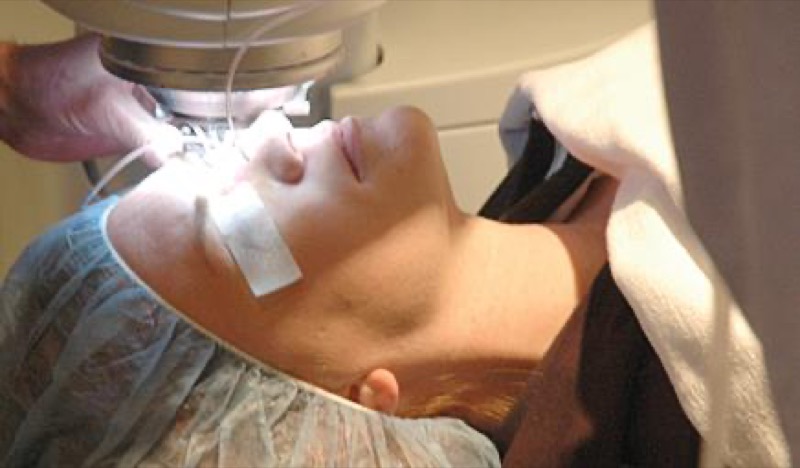
Shelena Maguire undergoes LASIK surgery to correct her vision. Prior to surgery, her vision was 20/200, as opposed to the regular 20/20. In a year, her vision should be measured at 20/20, although immediately after her surgery her vision had already improved. The surgery comes as a holiday gift, called The Gift of Sight, for which Shelena was nominated by her husband, Darrel.
In just minutes a nurse will take her back to a dimly lit room. Minutes later, her life will change.
Shelena has bad eyes. She sees at 20/200 as opposed to the normal 20/20, or even the required 20/40 for driving. She can’t see further than a foot in front of her without glasses.
“He’s ready for you,” a nurse says, holding the door as Shelena begins her trek down a long hallway to the room housing two lasers that will correct her vision.
Before entering the room, Shelena lays her black-framed glasses on the counter.
“That’s the last time you’ll need those,” Dr. Greg Sutton says as Shelena laughs.
It’s like she almost doesn’t believe him.
ooo
In November, Shelena found out that she was receiving a valuable Christmas present: The Gift of Sight from Sutton Linder and Sutton in Lincoln.
Doctors Greg Sutton, Vince Sutton and Max Linder will each perform a free LASIK eye procedure, a $4,000 value, for three candidates as a gift for the holidays.
Starting in September, nearly 300 applicants sent in letters revealing why they needed LASIK surgery. Patient essays were encouraged to tell Sutton Linder and Sutton about the patient’s life and vision, and how LASIK could improve both.
“They felt this year would be a good year to do it, especially with the way the economy is going,” said Deanna Bohl, director of marketing for the clinic.
Darrel Maguire, Shelena’s husband of 13 years, sent a letter to Sutton Linder and Sutton, asking for the surgery for Shelena. In November, after she was chosen out of 10 finalists, she became Dr. Greg Sutton’s candidate for free LASIK surgery.
Shelena was chosen along with patients Justin Modarres and Sarah Hahn.
ooo
With surgical cap in place, Shelena lies on a gray, padded bed. She folds her hands at her chest and fidgets with her wedding rings. Celine Dion belts out “Because You Loved Me” over an office speaker.
A nurse talks and jokes with Shelena. Shelena laughs with a hint of nervousness in her voice.
Soon the gray bed shifts to Shelena’s left and then up toward her head, positioning under the Intralase laser, the first of two lasers that Dr. Sutton will use on Shelena.
The laser will create a corneal flap that Dr. Sutton will pull back during the next step. Shelena’s hands press harder together.
After preparation, the laser takes just seconds to create the flap. Shelena’s eyes are now taped shut with white tape.
The bed shifts to Shelena’s right as she’s positioned under the next laser, the Allegretto Wave.
It will follow a 3-D map of Shelena’s eye to perfectly smooth out her cornea, targeting the smallest imperfections, allowing for better vision almost instantly.
A nurse pulls the tape off of her eyes.
“There’s your free eyebrow wax,” the nurse laughs.
Shelena smiles.
“I just got that done, actually.”
Here, it takes just five seconds on each eye for the laser to correct Shelena’s vision.
“I didn’t feel anything, except a little pressure. It was kind of neat— like a little laser light show.”
About five feet from Shelena’s vision on the wall is a clock. She sits up, with her hands now relaxed at her sides, and squints at the clock as eye drops drip out of the corners of her eyes.
“It’s one after two,” she says, and laughs. “Before I wouldn’t even have been able to see the hands.”
Looking at Dr. Sutton, with both tears and eye drops in her eyes, she thanks him.
“Now, this is why it’s worth it,” Bohl says.
“LASIK surgery is very rewarding. And then to have someone like this, who our Internet audience thought deserved this surgery, and she’s such a neat lady. That’s just the frosting, no, that’s the cherry on the frosting on the cake,” Dr. Sutton said.
Years of Problems
Thinking of the first snow this winter, Shelena can’t wait.
It’s been years since she’s been able to walk outside during the snow or rain without worrying about her glasses.
Normally during snow or rain, she steps outside and can’t see. Snow sticks to her lenses, or rain drops fog her vision.
Shelena has had glasses since her freshman year of high school.
From there, she’s dealt with the everyday problems of having those glasses, from not being able to see the clock in the morning to worrying about her glasses while she plays with her children.
“I really hate getting up and not being able to see the clock,” she said.
Darrel said its almost become routine. Shelena will wake up and turn to him, asking what time it is even though she’s close to the clock.
She can’t wait to see her kids, Dominic, 11, and Shyanna, 8, when they’re playing in the pool. Or to play with them without worrying about bending or scratching her glasses.
At work, glasses cause more headaches for Shelena. She has been a dispatcher for Gage County for the last nine years, wearing glasses the entire time. On top of her glasses, she has to wear a headset. It presses down on her glasses, giving her headaches. For the past nine years, she has just put up with it.
Contacts have never been an easy option for Shelena. At most, she tries them two times a year, with the same result—burning, itching, headaches.
“It never matters what kind, they always bother her,” Darrel said.
Shelena and Darrel have discussed LASIK surgery off and on for most of the 13 years of their marriage. Darrel knew how much the surgery would mean to her and how much it would change her life.
In October of 2006, Shelena was diagnosed with ovarian cancer. It was a blow to the whole family.
With her young age, doctors assured her that she would be able to overcome the cancer without treatment. But with one important and expensive surgery and regular check-ups every three months to monitor the cancer, LASIK surgery just wasn’t an option anymore.
She has been cancer-free for two years.
“It’s hard just to afford glasses,” she says, looking through a prescription she’s kept longer than necessary because of the cost of new glasses and eye checkups.
“I just can’t wait until everything is clearer. I can’t wait to see.”
The Letter
“I think Shelena has the most gorgeous eyes that I have EVER seen, and I’m not just saying this because I’m her husband.”
Darrel wrote about Shelena’s eyes in his letter to Sutton Linder and Sutton, nominating her for the Gift of Sight.
Darrel met Shelena when he was attending school at the University of Nebraska at Omaha. Both originally from Beatrice, they knew each other in passing.
Meddling friends made the first move, setting up a double date with Darrel, Shelena and another couple they knew.
Backing out of the date, the other couple left Darrel and Shelena to go on a blind date alone. They hit it off instantly and began dating frequently.
Soon, Shelena had to pack up and go to basic training for the Air Force. When training was finished, Darrel received a call from Shelena.
“Darrel, they’re sending me to England,” she frantically told him.
The last thing she wanted to do was leave Darrel and their blossoming relationship. So she abandoned all tradition, holding the receiver in her hand, and asked him:
“You want to get married?”
Darrel asked if she was serious, and knowing she was, he agreed.
“Hold on,” he told her amidst all the excitement. “I need to call your dad first. I need to see if it’s OK with him.”
With approval from Shelena’s father, the couple was married and Shelena moved to England. Not long after, Darrel followed.
For three years the newlyweds lived in England, and that was where their son, Dominic, was born.
Due to Shelena’s asthma, she was medically discharged in 2000.
To the excitement of family members, Darrel, Shelena, Dominic and Shyanna moved back to Beatrice.
The entire time, Darrel recalls that she struggled with her glasses.
“It’s not easy to do everything you need to do, in training and in the Air Force, when you have to worry about your glasses, because they can be scratched or bent.”
The first Darrel heard of the Gift of Sight was on television. He didn’t waste one second, he never had to think about it. He just submitted his nomination — a letter written about Shelena’s struggles with glasses and how much this surgery would mean to their whole family.
Due to her service in the Air Force, Darrel knew friends from all over would be willing to help her win this competition.
Soliciting the help of friends nationwide and even internationally, Shelena received more than 30 percent of the votes for LASIK eye surgery.
The contest showed that people from 30 states and 17 countries had submitted votes. Darrel was stunned.
“It wouldn’t have happened if it wasn’t for them,” he insists.
It wasn’t until a couple days before she received the winning phone call that Darrel broke the news to her.
“I entered you into this contest for free LASIK surgery.”
He said her reaction wasn’t nearly excited.
“I think she was indifferent. She didn’t know what to say. It was an overwhelming idea that she was put in for this.”
The Result
“Now Shelena, I want to warn you,” Buhl started as Shelena and Darrel sat together after the surgery. “When you take a shower tomorrow, you’ll notice that the shower isn’t as clean as you thought it was.”
Buhl then told Darrel of how Shelena could see the time on the clock.
“I don’t have to tell her what time it is anymore? Awesome.”
Shelena answered everyone’s questions with eyes closed.
She had to keep her eyes closed as much as possible for eight hours after the surgery. When she next opened her eyes, she would notice a drastic change in her vision.
The next day, Shelena woke up with no desire to grab her glasses.
“I did get up in the middle of the night to look at the clock because I just couldn’t believe it,” she said.
Her eyes, formerly 20/200 without her glasses, were now 20/15 in the right eye and 20/25 in the left.
The left, Dr. Sutton said, would get better as the days went on. It had more damage than the right.
As Shelena looked around on Thursday morning, she was amazed. Although she couldn’t feel the weight of her glasses on her face, she thought she might be wearing them.
“It looks exactly like it did when I was wearing my glasses,” she said.
Just one day after surgery, Shelena was able to go back to work.
An incentive for work post-surgery? No more headaches from her glasses.
“It’s unbelievable,” she said. “Unbelievable. I just can’t believe it.”